Syrinx Music
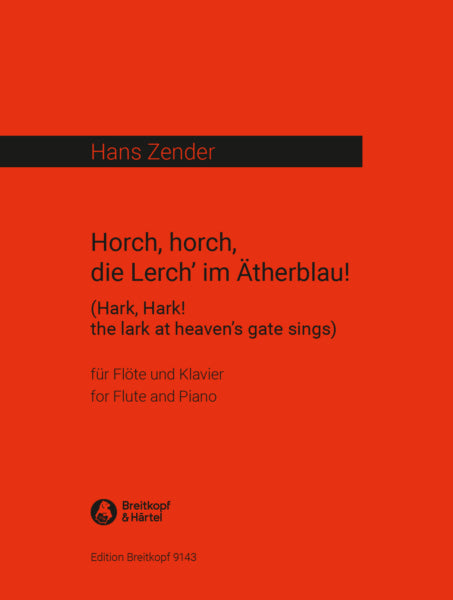
Zender, Hans - Hark, hark! the lark at heaven's gate sings (Digital Edition)
Zender, Hans - Hark, hark! the lark at heaven's gate sings (Digital Edition)
Couldn't load pickup availability
This Edition will be personalized for you by the publisher and emailed within 24/48 hours
World premiere: Graz, February 2003
Commissioned by the international competition “Schubert und die Moderne” of the University of Graz
The flute is my favorite instrument – I've written for it time and again. So I couldn't resist a request for a piece for flute and piano for the 2003 Graz Competition. It had to be virtuosic for both players and have something to do with Schubert. "Perhaps one should quote the song 'Hark, horch, die Lerch' im Ätherblau...', it sounds so birdlike and flute-like," I said jokingly on the phone. But then I took a look at this song, which I had previously only known from the table of contents of a Schubert volume, and was immediately captivated by its innate intoxication of an ecstatic, blissful floating, the kind only Schubert can create. The Shakespearean original of the poem, translated by Schlegel, was soon found, and I liked the idea of providing a translation, or rather, a commentary, on Schubert's music.
First, I invented two basic movements for my music: a very lively, dynamic, fluttering, and dancing character, which also hints at some of the phrases of "real" lark song, and an extremely slow character, changing only in tiny nuances, which, like a bird "standing" in mid-air, defines the sound through its constant fluttering. Both characters were to alternate several times. The connection to the Schubert song was established by the first six notes of the Schubert melody. This melody reveals its own internal logic particularly clearly when its fifth and sixth notes are raised by a semitone:
In this form, it forms the structural basis for the pitch movements throughout my piece. It also appears in the coda as almost inaudible bass notes through the chaotically dissolving texture: While the flute, in double and flutter tonguing, increasingly approaches the realm of the inaudible, the spectra above the aforementioned bass notes, inaudibly struck and held by the piano, are aroused by explosive glissandi and clusters, so that instead of a "real" sound, only a kind of horizon of sound is produced. And lo and behold, just before the end, hidden at the highest pitch: don't tiny fragments of the "true" Schubert appear there, flashing briefly like rays of sunlight?
(Hans Zender, 2006)
Share