Syrinx Music
Piazzolla, A- Tango-Etudes arranged for two flutes
Piazzolla, A- Tango-Etudes arranged for two flutes
Couldn't load pickup availability
Tango-Etudes
Piazzolla, A
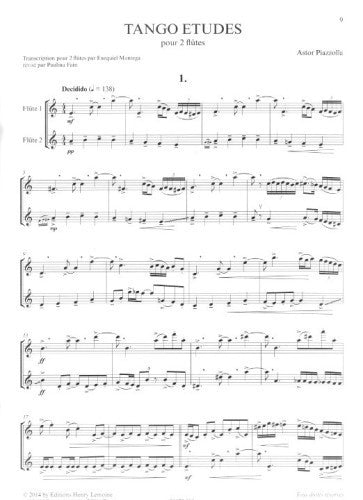
Editions Henry Lemoine presents Astor Piazzolla's 'Tango etudes', in a version for 2 flutes edited by Exequiel Mantega and reviewed by Paulina Fain.
Foreword: Like any popular music, tango has its own peculiarities that define it, generating a number of resources which a player can and should use when interpreting a work. Fundamental to this is the contrast and coexistence between tango's rhythmic and expressive fields. Each of these has characteristic features requiring a different interpretation, if the score is considered within an academic performance.
Astor Piazzolla was one of the greatest composers in the history of tango. In his '6 Tango Etudes', he employed a wonderfully large amount of resources used by the 'Orquesta Tipica' in its various functions: expressive singing, rhythmic walking, connective passages, elements of rhythmic-harmonic timekeeping patterns, among others. In this edition, the original melody has been divided between the two performers in order to create a dialogue. Extended flute techniques applicable to tango have also been added. To achieve a deep understanding of these works it is essential that the interpreter study all the elements that define tango. This can be achieved through the study of tango method books, and by listening to recordings of the outstanding traditional tango orchestras.
in 1937 the Piazzolla family returned to Mar del Plata, but Astor was soon attracted more to the capital, and when only sixteen he moved to Buenos Aires, renting a small room as a lodger. He had been engaged as a bandoneon player in the band directed by Anibal Troilo, himself a specialist on the instrument, and was thus able to pay the rent with his first fees. At the same time he did not neglect his studies but took lessons in piano and harmony with a young teacher by the name of Alberto Ginastera, who went on to become a renowned composer.
in 1946 Astor got his own 'tipica' band together, playing nothing but tangos. It was the springboard he needed for his own development: 'I played my own arrangements, and started using triple rhythms in what had been a very four-square rhythmic pattern up to then, and experimenting with bold harmonies'. His innovations, however, met with little success and the group disbanded. He renewed his studies even more enthusiastically and founded a new string orchestra - which led him right back to failure and bitter disillusionment. Still he persisted; his hard upbringing in New York had taught him to be stubborn, with an aggressive edge.
The turning point came when Astor travelled to Europe in the 1950s to study conducting with Hermann Scherchen, and met Nadia Boulanger, the famous teacher of composition in Paris. She showed him that his identity was not in intellectual music but in the tango, spiced with a touch of classical style and jazz, and molded by his own intuitive sense.
Once back in Buenos Aires he formed his first octet in 1955 and, by using what he had learned from Ginastera and Boulanger, as well as phrasing borrowed from jazz, he made his tangos swing with new life. As was to be expected this caused quite a stir in the ranks of the conservative tango players, but Piazzolla was not to be deflected from his new course. From now on his tango was a distinctively modern form that he exploited with his new quintet which achieved fame for their 'tango nuevo'. International recognition was at last his, and concerts and recordings flowed unceasingly. From the 1960s until his death in July 1992, his success never stopped growing.
From 1980 onwards, many classical guitarists started playing his music, and it was in response to a commission from the Argentinian guitarist Roberto Aussel that Piazzolla began writing for the guitar. His 'Histoire du Tango' for flute and guitar, as well as the 'Double Concerto' for guitar, banoneon, and string orchestra, are regularly performed and have been the subject of several recordings.
Share